



Bitcoin surged toward $80,000 on Friday, extending a three-day rally that has liquidated more than $4 billion in bearish bets and pushed the cryptocurrency to a three-month high.
Data from CryptoCho/em> shows Bitcoin climbed as high as $78,449, gaining more than 10% over the past 24 hours before easing to $77,873 as of press time.
The rally began Wednesday after the US Treasury said it would at least double liquidity-support buybacks for 10- to 30-year government debt, sending long-term yields lower and improving risk appetite.
Momentum accelerated as President Donald Trump hosted crypto executives at the White House and urged Congress to advance the CLARITY Act, while the SEC and CFTC moved ahead with additional industry-friendly proposals.
Institutional demand also strengthened. SoSoValue data shows spot Bitcoin exchange-traded funds have attracted more than $1 billion since Wednesday, adding fresh buying as Bitcoin broke through resistance levels that had capped earlier recovery attempts.
Derivatives positioning then magnified the move. CoinGlass data shows more than $4 billion in Bitcoin shorts have been liquidated since Wednesday as the asset jumped from around $65,000 through $70,000 and then above $75,000.
Bitcoin’s bull signal confirms what May’s $82,000 rally could not
A market indicator that remained bearish during Bitcoin’s previous recovery is now confirming the price surge.
CryptoQuant’s Bitcoin Bull Score Index has climbed back to 60, marking its first return to bullish territory since October 2025.
The shift is notable because the index failed to cross that threshold even when Bitcoin rallied above $82,000 in May, suggesting the current advance is being accompanied by a broader improvement in underlying market conditions.
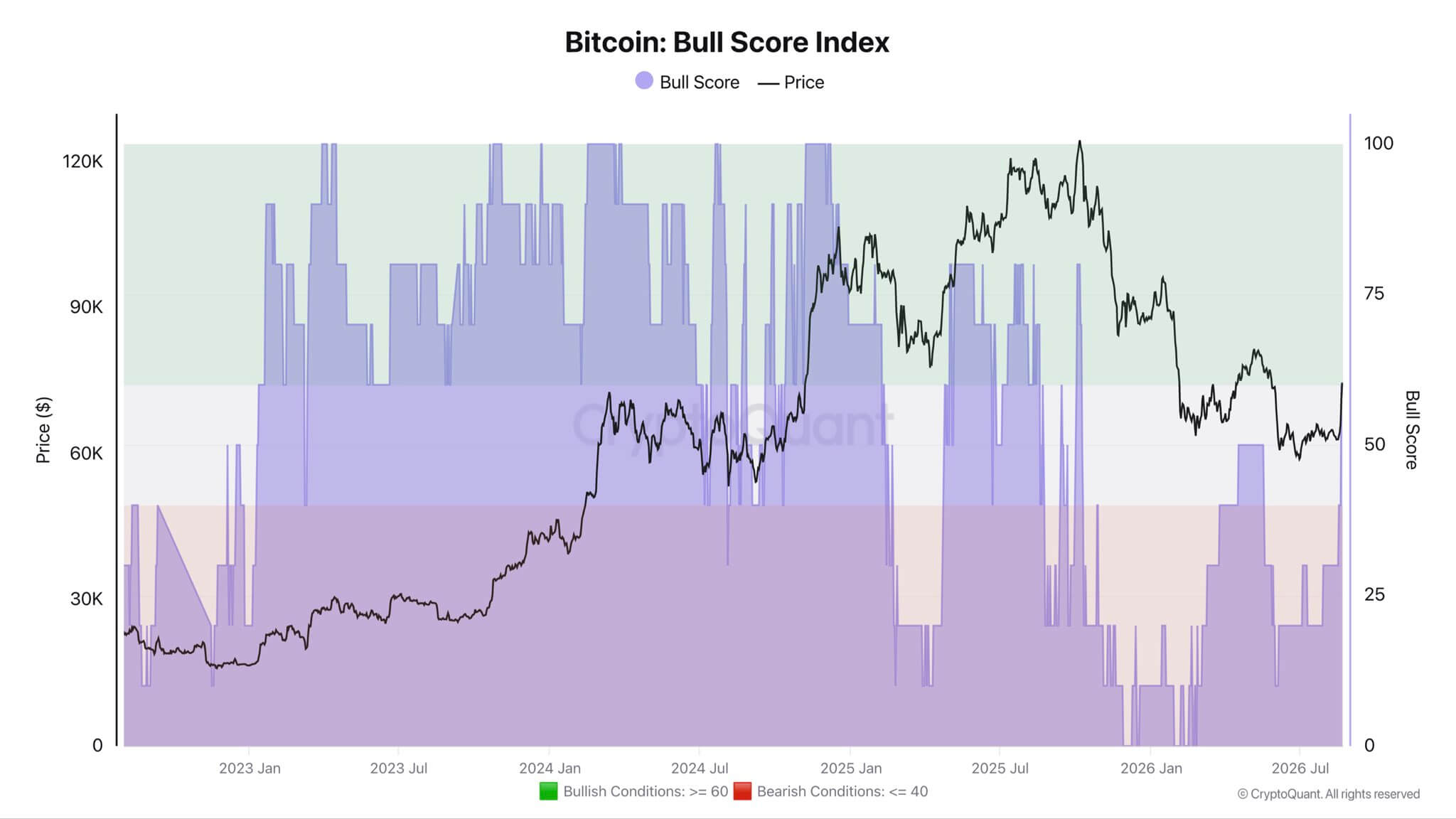
Six of the index’s 10 components have turned positive, including demand growth, stablecoin liquidity, and trader realized price. CryptoQuant uses the indicators collectively to assess whether Bitcoin is trading in a predominantly bullish or bearish regime.
During sustained bull phases, the index has historically spent much of its time above 60 before eventually falling back into bearish territory. Holding above that level and moving higher would strengthen the case that Bitcoin is undergoing a broader regime shift rather than simply another sharp rebound.
Still, Joao Wedson, chief executive of Alphractal, remains skeptical that the current rally marks a durable change in market trend.
Wedson said sharp short squeezes are common during bear markets and can make brief rebounds look like the start of a new uptrend before demand and volume are strong enough to support the move.
He stated:
“For now, I see this move as nothing more than a relief rally. In my view, nothing has changed yet.”
Bitcoin’s rally now faces a different test
Nevertheless, Bitcoin’s continued climb toward $80,000 has kept the breakout intact, but the rally is entering a more demanding phase as the short squeeze clears out much of the bearish positioning that helped accelerate the move.
Nicolai Søndergaard, senior research analyst at Nansen, told CryptoCho/em> that short covering amplified the rally rather than created it.
According to him, ETF inflows and broader spot demand also supported the advance, helping Bitcoin reclaim its 20-week and 200-day moving averages and move above the estimated short-term holder cost basis near $68,700.
More than $4 billion in Bitcoin shorts have been liquidated since Wednesday, forcing bearish traders to buy back positions as prices rose. That added momentum to demand already coming from ETFs and other spot buyers.
The resulting shift in positioning is now creating a different risk. Søndergaard said momentum is stretched, funding has turned positive, and leveraged traders are increasingly crowded long.
While those conditions do not signal that the breakout is ending, they make continued spot demand more important as forced short covering becomes a smaller part of the move.
Meanwhile, Washington has also become an important signal for the market.
Lacie Zhang, research analyst at Bitget Wallet, told CryptoCho/em> that Bitcoin is beginning to trade with a US political premium as the Trump administration pushes to advance crypto legislation ahead of November’s midterm elections.
Zhang said the timing could matter as much as the substance. The administration has an incentive to show progress on borrowing costs, financial markets and emerging industries before the midterms, while the crypto sector has reason to secure the CLARITY Act legislation before a change in the congressional balance makes further action harder.
That political premium could also become a vulnerability. Failure to advance the CLARITY Act, renewed disputes over the administration’s crypto policies or a slowdown in regulatory momentum after the elections could quickly weaken part of the support now being priced into Bitcoin.
For now, however, the rally has continued even as one of its original macro tailwinds has weakened.
That leaves spot and ETF demand as the clearest test of what comes next. As the pool of vulnerable short positions shrinks, further gains will increasingly depend on investors continuing to buy Bitcoin at higher prices rather than on forced covering alone.
The post Bitcoin is closing in on $80,000 and already destroyed a record $4 billion in short bets appeared first on CryptoCho