


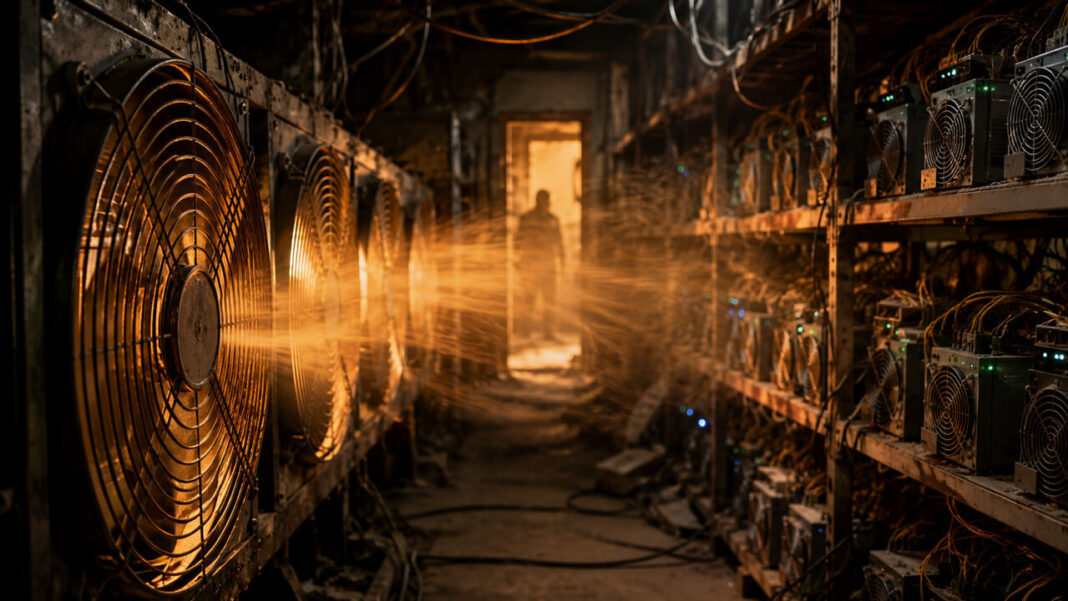


Rio de Janeiro Civil Police launched an operation targeting a Comando Vermelho operational nucleus and found a crypto mining setup with roughly 30 computers arranged on shelves in a room on an apparently abandoned lot.
The farm drew power from a clandestine electrical connection running directly from a utility pole. The machines carried high-capacity fans and exhaust systems, including remote-monitoring hardware.
As G1 reported, police are investigating whether the faction used the structure for money movement or laundering.
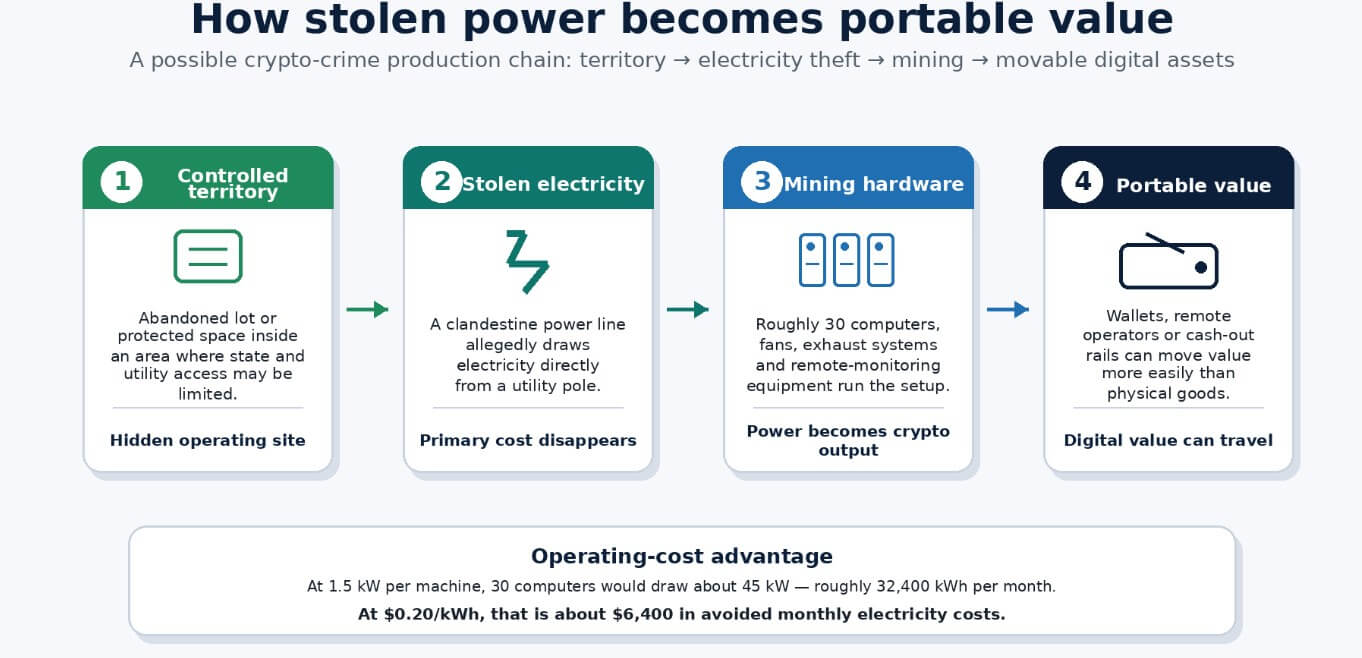
The physical configuration already describes the possibility that a criminal organization with territorial control can convert stolen electricity into portable digital value.
Territorial control provides access to space and utilities, a clandestine electricity connection eliminates the primary operating cost, and the mining output converts directly into portable value.
Stolen electricity is the load-bearing element of that model, since mining only makes economic sense when electricity is cheap, subsidized, or free.
Cambridge’s Bitcoin Electricity Consumption Index methodology identifies electricity as one of mining’s highest operating costs. Brazil’s electricity regulator, ANEEL, reported that energy theft and other non-technical losses cost the country roughly $2 billion in 2024, with Rio de Janeiro among the states recording the highest levels of power theft.
At 1.5 kilowatts per machine, 30 computers would draw about 45 kilowatts, consuming about 32,400 kilowatt-hours per month. At $0.20 per kilowatt-hour, that is $6,400 in avoided monthly electricity costs, a real operating advantage delivered without payment.
The unknowns are the hardware type, the coin mined, the hash rate, and whether the crypto was ever cashed out. Stolen electricity removes one of mining’s highest variable costs regardless of those unknowns.
Comando Vermelho’s infrastructure evolution
The UK Home Office identifies Comando Vermelho as one of Brazil’s two largest organized criminal groups alongside PCC, with territorial reach across urban favelas, border areas, and the Amazon.
The organization originated in Rio’s prison system in the late 1970s, expanding into international cocaine trafficking and control of working-class neighborhoods where armed groups often manage basic services, including gas, internet, and transportation.
AP reported in 2025 that Rio police accused Comando Vermelho of coercing over 300 motorcycle drivers into using a clandestine ride-hailing app in Vila Kennedy, generating up to $200,000 per month, with revenue allegedly funneled through shell companies to finance drug trafficking.
On May 4, local news Folha reported that CV had intensified its presence in illegal gold mining near Brazil’s border with Peru, treating gold as a profitable and stable alternative to cocaine and using the activity for investment and money laundering.
| Activity | Controlled resource | Revenue logic | Why it matters |
|---|---|---|---|
| Drug trafficking | Territory, armed control, routes | Traditional illicit commodity flow | Core historical business |
| Clandestine ride-hailing app | Local transport networks | Fees from coerced drivers / shell-company flows | Shows control over urban services |
| Illegal gold mining | Land, extraction zones, cross-border access | Gold as investment and laundering vehicle | Shows move into commodities |
| Crypto mining setup | Space, stolen electricity, hardware | Converts unpaid power into digital value | Shows possible move into crypto production |
Each activity monetizes territory and controlled resources as a standalone revenue line, with transaction flows that run outside the cash-and-drugs channels investigators have historically targeted.
The Rio findings also sharpen the current picture of crypto crime in Brazil.
Folha reported on May 9 that Brazil’s Federal Police seized $14 million in crypto in 2025, with seized assets appearing across drug trafficking, money laundering, human rights violations, environmental crimes, and online fraud.
On May 12, a national operation spanning 16 states deployed 165 search-and-seizure warrants and 71 arrest warrants focused on drug trafficking, criminal factions, and money laundering.
Chainalysis’ 2026 Crypto Crime Report described the illicit on-chain landscape as having built large-scale infrastructure to help transnational criminal networks procure goods and launder crypto.
A Malaysian comparison provides the stolen power model with global context, as reports have noted that Malaysia’s national utility, Tenaga Nasional, lost more than $1 billion to illegal power use by crypto miners between 2020 and August 2025.
Malaysian authorities responded with raids, smart meters, and databases of suspicious premises.
Where the grid trail leads
In the bull case, police link the setup to faction finances, locate wallet addresses or remote operators connected to CV leadership, and the case becomes the first documented example of a major Brazilian criminal faction running crypto production as a formal revenue line.
The investigative perimeter would then need to expand to include hardware procurement, power theft, cooling equipment, and utility access.
| Scenario | What investigators find | What it would mean | Story implication |
|---|---|---|---|
| Bull case | Wallets, remote operators or financial links tied to CV leadership | Crypto mining becomes part of faction finance | Major Brazilian faction may be using crypto production as a revenue line |
| Base case | Local operators used CV-controlled territory but with weak central links | Territorial control enabled the setup indirectly | Still shows how gang territory can shelter crypto infrastructure |
| Bear case | Independent operators, no faction wallet trail, limited revenue | Opportunistic power theft, not faction strategy | Story becomes a local energy-theft case |
| Black-swan case | Multiple farms, coordinated hardware purchases, exchange accounts or cross-border cash-out | Replicable criminal mining infrastructure | Police may need to monitor grids as closely as blockchains |
In the bear case, investigators identify independent operators who opportunistically used a CV-controlled area, find no faction wallet trail, and the setup generates too little revenue to function as a viable operation.
Investigators seize the machines, operators face energy-theft charges, and the case closes as a local footnote.

The configuration of clandestine power, remote monitoring, an abandoned lot, and a controlled neighborhood serves as a replicable model for anyone with access to a gang-controlled grid.
The power line shows that organized crime can build crypto-production infrastructure from territorial control, stolen electricity, and off-the-shelf hardware, forcing investigators to watch the grid as closely as they watch the blockchain.