


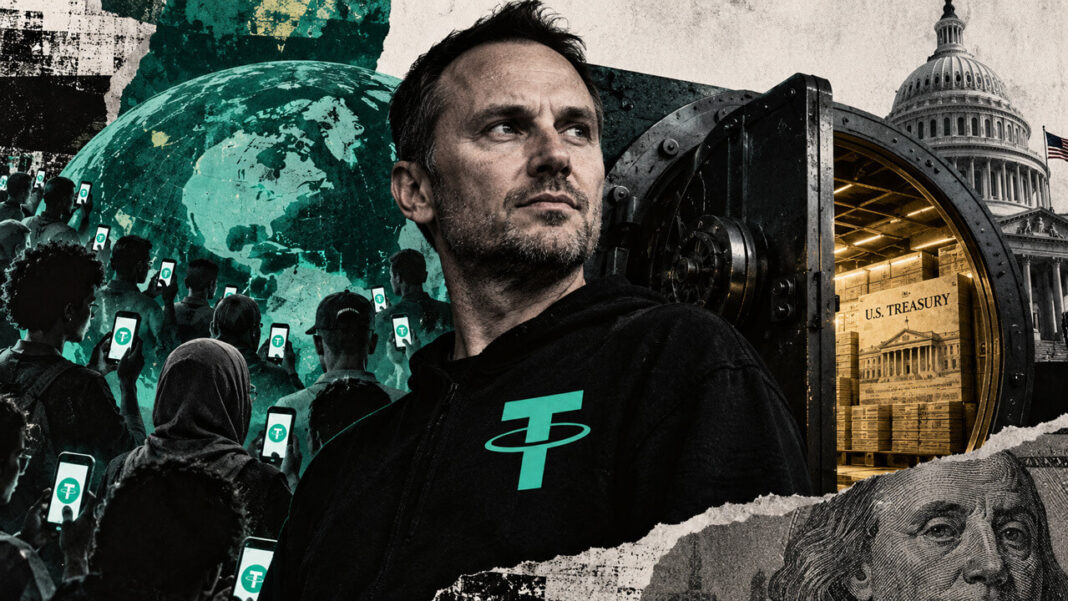
Paolo Ardoino offered a striking answer to a familiar U.S. debt problem: replace concentrated foreign buyers with hundreds of millions of stablecoin users.
In an Aug. 31 episode of The Wolf of All Streets, the Tether CEO said the company had created “the decentralized ownership of the US debt” through 650 million people who were “basically holding some US Treasuries.” His point was about concentration risk. Unlike a foreign government, hundreds of millions of users are unlikely to decide together to sell U.S. debt in a single morning.
The macroeconomic intuition has force. Demand for USDT gives Tether funds that it can place in a Treasury-heavy reserve portfolio. But calling token users owners of government debt collapses several different relationships into one. Tether’s own documents say users own USDT, eligible verified customers have a personal contractual right to redeem, and Tether International owns and manages the reserve assets.
Related Reading
How stablecoins are quietly becoming the Fed’s debt buyer of last resort
The 650 million figure is also attributable to Tether, not an independently established count of Treasury investors. In an Aug. 13 audit announcement, the company said more than 650 million users across emerging markets rely on Tether daily, without publishing a methodology for that figure.
Tether’s earlier work shows why “users” needs qualification. Its 2024 methodology note treated on-chain addresses or accounts as a proxy and upper-bound estimate, acknowledging that one person can control multiple wallets. It then added estimates for people holding USDT through centralized services. Tether’s fourth-quarter 2025 report used that broad approach to estimate 534.5 million users at year-end.
Those measures are useful for estimating reach, but they do not establish 650 million unique people, 650 million current holders or 650 million customers able to redeem directly with Tether. They establish the scale Tether assigns to its network.
What USDT holders actually own
Tether’s current terms call the right to purchase or redeem tokens a personal contractual right. They also say issuance and redemption are administered by Tether and require the customer to be verified.
The company’s Relevant Information Document makes the allocation of control clearer. After a verified customer sends fiat and receives tokens, Tether says it holds or invests the funds in a basket of reserves. The composition of that basket can change at Tether’s sole discretion, and Tether says it primarily holds the assets through banks and licensed financial institutions.
Its latest Financial Figures and Reserves Report uses similarly direct accounting language. It describes the reserves as assets owned by Tether International and the issued tokens as refund liabilities recorded at their contractual redemption value.
That arrangement is not the same as owning a Treasury bill through a brokerage account or holding a beneficial interest in a fund that passes through portfolio economics. USDT holders own transferable tokens. The reserve assets sit on the issuer’s side of the structure.
Relationship
What Tether’s documents provide
USDT holder
Ownership or control of a transferable token denominated in dollars
Eligible direct customer
A personal contractual right to redeem with Tether, subject to its terms
Reserve owner and manager
Tether International owns the assets and chooses the portfolio composition
Reserve investment gains
Holders are not entitled to gains above token face value
The documents do not eliminate holder rights. They define them more narrowly. The Relevant Information Document says an eligible redemption is paid at the token’s face value in fiat, less fees. It also says holders are not entitled to increases in reserve value above face value. The income and gains from the portfolio therefore do not flow through to USDT holders merely because Treasuries back the token.
Direct access to that redemption promise is also narrower than USDT’s global circulation. Tether’s fee schedule sets a $100,000 minimum for direct acquisition or redemption. A redemption costs the greater of $1,000 or 0.1%. Applicants must complete verification, and Tether retains sole discretion to approve or reject requests to become verified customers.
The legal terms allow Tether to delay or suspend services, including redemptions, in circumstances involving suspected prohibited use, legal requirements, government directions, investigations, unauthorized access or risks that Tether considers unacceptable. Fees can change.
Holders can still sell USDT through secondary markets, subject to the rules and liquidity of the exchanges, dealers or other platforms they use. That is a market exit, however, rather than a direct exercise of the issuer contract. It may transfer the token to another buyer instead of shrinking Tether’s outstanding liabilities.
The distinction also limits what can safely be said about creditor priority. Tether’s public materials establish an issuer liability and an eligible customer’s redemption right. They do not establish one universal insolvency ranking for every secondary-market holder across every jurisdiction.
Related Reading
Stablecoins are becoming a central bank problem hiding in T-bill markets
The Treasury exposure is real and large
None of this makes the reserve portfolio economically irrelevant to users. USDT’s reliability depends in part on Tether’s ability to meet its obligations, and the composition and liquidity of the reserves are central to that ability.
As of June 30, Tether International reported $187.751 billion in reserve assets against $183.642 billion in liabilities. The portfolio included $114.961 billion of direct U.S. Treasury bills.
It also reported $18.626 billion of overnight reverse-repurchase exposure, collateralized by about $18.596 billion of U.S. Treasuries. Those are distinct positions. Directly owned bills and Treasury collateral supporting a repo should not be combined and described as if they create the same legal relationship.
Related Reading
US treasury relies on stablecoins to fund short-term debt, but they can’t fix its $28B long-bond problem
The scale helps explain Ardoino’s framing. Broad demand for USDT can create broad economic dependence on a company whose reserve allocation generates substantial demand for short-term government debt. Earlier CryptoChoanalysis has examined Tether’s Treasury scale and the risks embedded in U.S. debt markets and how stablecoin issuers can become marginal buyers as other holders retreat.
The ownership question is different. Tether can spread dollar access across wallets and platforms, and rising issuance can increase the pool it allocates partly to Treasuries. It does not follow that each user owns a pro rata slice of those bills, can direct their sale or receives their yield.
A more precise description is that USDT decentralizes the distribution of an issuer-mediated dollar claim. The associated funding demand is geographically dispersed. Legal title to the reserves, portfolio control and the economics above token face value remain centralized at Tether. Ardoino’s macro intuition is directionally meaningful, but the legal and economic plumbing remains issuer-mediated.
The post Paolo Ardoino says 650 million people decentralized US debt, but Tether still controls the T-bills appeared first on CryptoCho