



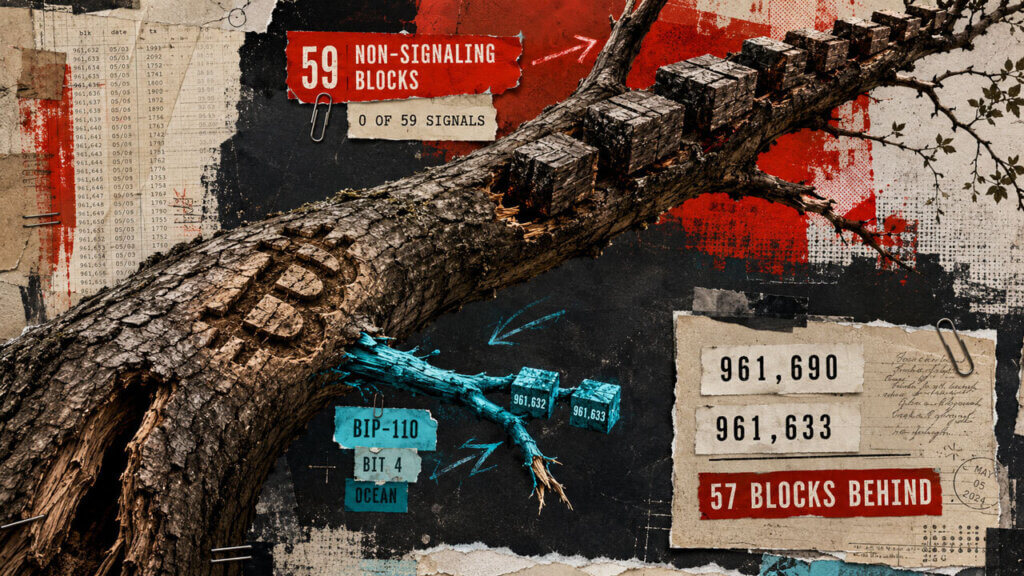
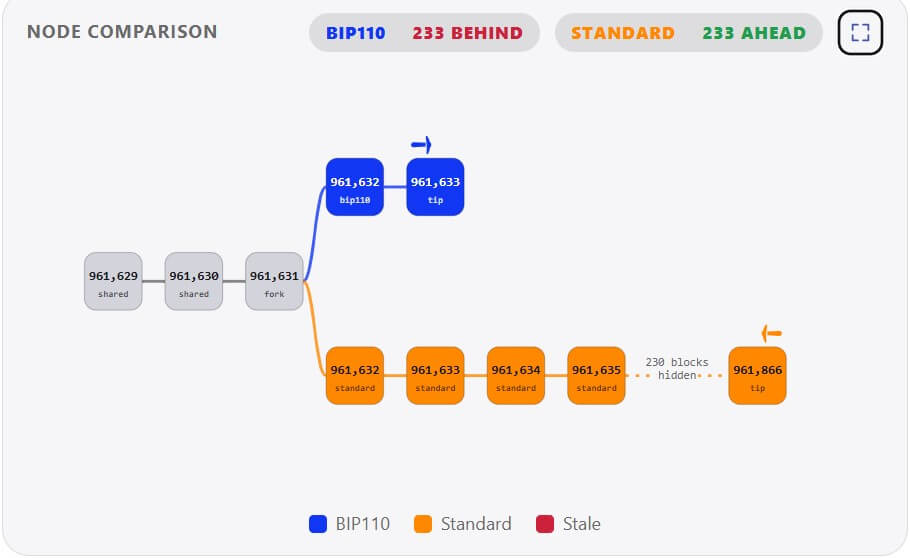
Bitcoin’s BIP-110 push failed to gain meaningful mining support over the weekend, leaving the proposal stranded on a minority chain that produced only two blocks before stalling at height 961,633.
The soft fork was designed to temporarily restrict several forms of arbitrary data on Bitcoin and required 55% miner signaling during its deployment window.
Instead, signaling peaked at only a few percentage points before mandatory signaling began at block 961,632, where BIP-110 nodes rejected blocks they considered invalid and split from the dominant chain. Roughnecks mined the minority branch’s first two blocks, but no third block followed.
This outcome had shifted the debate from whether BIP-110 could activate to what should happen to it and to one of its most visible backers, Bitcoin developer Luke Dashjr.
BIP-110 collapse sparks backlash against Dashjr
The weekend split drew sharp criticism from Bitcoin figures who framed the outcome as a rejection of BIP-110.
Strategy Executive Chairman Michael Saylor said roughly 99.85% of Bitcoin’s hashpower remained on the dominant chain, leaving BIP-110 with about 0.15%. At that rate, he estimated the minority branch could take about 25 years to mine the 2,016 blocks needed for its first difficulty adjustment.
“Consensus is earned, not declared,” Saylor said, arguing that miners, exchanges, custodians, wallets, holders and other economic infrastructure had overwhelmingly remained with the dominant network.
David Bailey, the CEO of Bitcoin treasury company Nakamoto, was more dismissive, calling BIP-110 the least popular and most inconsequential soft fork ever attempted and saying its backers should reflect on the failed activation.
Meanwhile, the softfork fallout has quickly moved beyond the fork itself.
BIP editor Mark “Murch” Erhardt on Sunday proposed removing Dashjr from the BIP editorial team, accusing the veteran developer of using his position inconsistently while advocating BIP-110.
Murch said Dashjr attempted to assign the proposal a number before the usual mailing-list discussion and later merged an update within minutes of a related pull request being opened.
The proposal has since been turned into GitHub pull request 2248, which remained open Monday.
Several Bitcoin developers backed the removal effort. Matt Corallo supported the motion, while fellow BIP editor Olaoluwa Osuntokun formally seconded it. Jonas Nick also supported removing Dashjr, saying BIP editors should apply the process neutrally.
Antoine Riard said Dashjr should step aside, at least temporarily, but warned that the BIP process does not provide a clear procedure for forcibly removing an editor.
The dispute therefore leaves developers debating Dashjr’s conduct and how such a decision should be made.
BIP-110 supporters restart mining and push PoW change
BIP-110 supporters are responding to the setback by challenging the premise that their branch lost a legitimate consensus fight.
Dathon Ohm, the proposal’s author, accused large mining pools of colluding to turn Bitcoin into a “toxic data dumping ground” by mining blocks rejected by BIP-110 nodes. He said supporters were working on a proof-of-work change intended to “fire the miners.”
Dashjr backed that position, arguing that BIP-110 still has community support and that only a small number of bad actors were attacking it. He said:
“There’s just a tiny few bad actors attacking it. PoW change eliminates their threat.”
A proof-of-work change would represent a far more disruptive escalation than BIP-110’s original soft fork. Bitcoin miners currently rely on specialized SHA-256 hardware, so an incompatible algorithm would create a separate mining environment and force supporters to build their own base of miners, wallets, exchanges, liquidity, and users.
Roughnecks, the pseudonymous mining group that found both blocks on the BIP-110 branch, now says it intends to keep that chain alive while such a change is considered.
On Aug. 10, the group said that it would resume mining from block 961,633 after initially suspending operations.
It claimed miners on the dominant chain had “forked themselves off the network” and described Bitcoin Knots-RDTS as Bitcoin’s reference client, a characterization rejected by opponents of BIP-110.
“We have decided to resume mining ASAP on the stalled chain tip,” Roughnecks said, adding that it would continue until a “sensible POW change” could replace the mining pools it blamed for abandoning the branch.
The reversal comes less than two days after Roughnecks said mining under the existing proof-of-work setup was largely wasteful and advised other BIP-110 miners to pause.
Its decision means the minority branch could begin producing blocks again, though it still carries Bitcoin’s existing difficulty level and has only a fraction of the computing power securing the dominant network.
Dashjr also rejected the push to remove him as a BIP editor. He called Murch’s accusations false, said he had followed the BIP process consistently for years, and countered that Murch should be removed instead.
The result leaves BIP-110 in an unusual position. Its weekend activation failed to win over miners, and its branch stalled after two blocks, yet its supporters are now trying to revive that chain while laying the groundwork for a proof-of-work change that could turn a failed soft-fork campaign into a broader fight over who gets to define Bitcoin’s rules.