



Elon Musk’s SpaceX has turned one of the world’s largest artificial intelligence clusters into a commercial compute product, creating a new challenge for Bitcoin miners racing to recast themselves as AI infrastructure companies.
Anthropic said it reached a deal to use the full computing power of SpaceX’s Colossus 1 facility in Memphis, Tennessee, giving the Claude maker more than 220,000 Nvidia processors and 300 megawatts of new capacity within a month.
The added capacity helped Anthropic double Claude Code rate limits for paid plans, remove peak-hour usage caps for Pro and Max accounts, and sharply increase developer request volume for its Claude Opus models.
The agreement gives SpaceX a marquee AI customer as it tries to show investors that its infrastructure ambitions extend beyond rockets and satellites.
It also lands directly in the market Bitcoin miners have been trying to enter: the race to secure power for data centers for AI firms that need electricity faster than the grid can deliver it.
For miners, the problem is no longer only Bitcoin’s price, network difficulty, or the next halving. The new question is whether they can compete with technology giants, neoclouds, and Musk-linked infrastructure platforms in the race to convert electricity into AI revenue.
Miners move toward compute
Bitcoin miners have spent the past year arguing that their future will be shaped less by block rewards and more by powered sites, long-term leases, and AI compute demand.
That shift accelerated after the 2024 Bitcoin halving, which cut the block subsidy paid to miners and tightened an already difficult margin structure.
CoinShares said the fourth quarter of 2025 was the most difficult period for miners since the halving, as Bitcoin’s price correction and near-record hashrate pushed hashprice to five-year lows.
The firm said hash price fell further in the first quarter to about $29 per petahash per second per day, extending pressure on operators with older machines and higher power costs.
As a result, BTC mining economics have pushed several public miners toward AI and high-performance computing.
CoinShares said listed miners could generate as much as 70% of their revenue from AI by the end of this year, up from roughly 30% today. The firm also said that public miners have announced more than $70 billion in aggregate GPU colocation and cloud service agreements with hyperscalers and AI customers through 2025 and early 2026.
That transition is already visible in the sector’s corporate map. BTC miners like TeraWulf, Core Scientific, Cipher, and Hut 8 have increasingly become data-center operators that still mine Bitcoin.
Other miners, including IREN and Bitfarms, are using mining as a bridge into high-performance computing, while some operators remain more closely tied to Bitcoin mining and low-cost energy strategies.
The distinction has become central to investor valuations. CoinShares said miners with secured HPC contracts trade at enterprise-value-to-next-12-month sales multiples of 12.3 times, compared with 5.9 times for pure-play miners.
The result is a sector split between infrastructure companies with AI exposure and mining companies whose earnings still move more directly with Bitcoin’s price and hash price.
Power becomes the trade
Meanwhile, the miner pivot has gained traction because AI demand has exposed a bottleneck that mining companies understand better than most: access to large-scale electricity.
AI developers need chips, but chips are only useful when they can be installed in facilities with power, cooling, and grid connections. That has shifted market attention toward energized sites capable of supporting dense computing loads.
Artemis, a blockchain analysis firm, has argued that the AI trade may be more about power than chips, pointing to a projected roughly 50-gigawatt US data-center power deficit through 2028.
The firm also described BTC miners such as IREN, Core Scientific, and TeraWulf as AI infrastructure companies hiding in plain sight.
At the same time, Artemis noted that the Bitcoin miner AI theme rose 56% over the past month, ahead of baskets tied to AI chips, data centers, power, and other infrastructure segments.
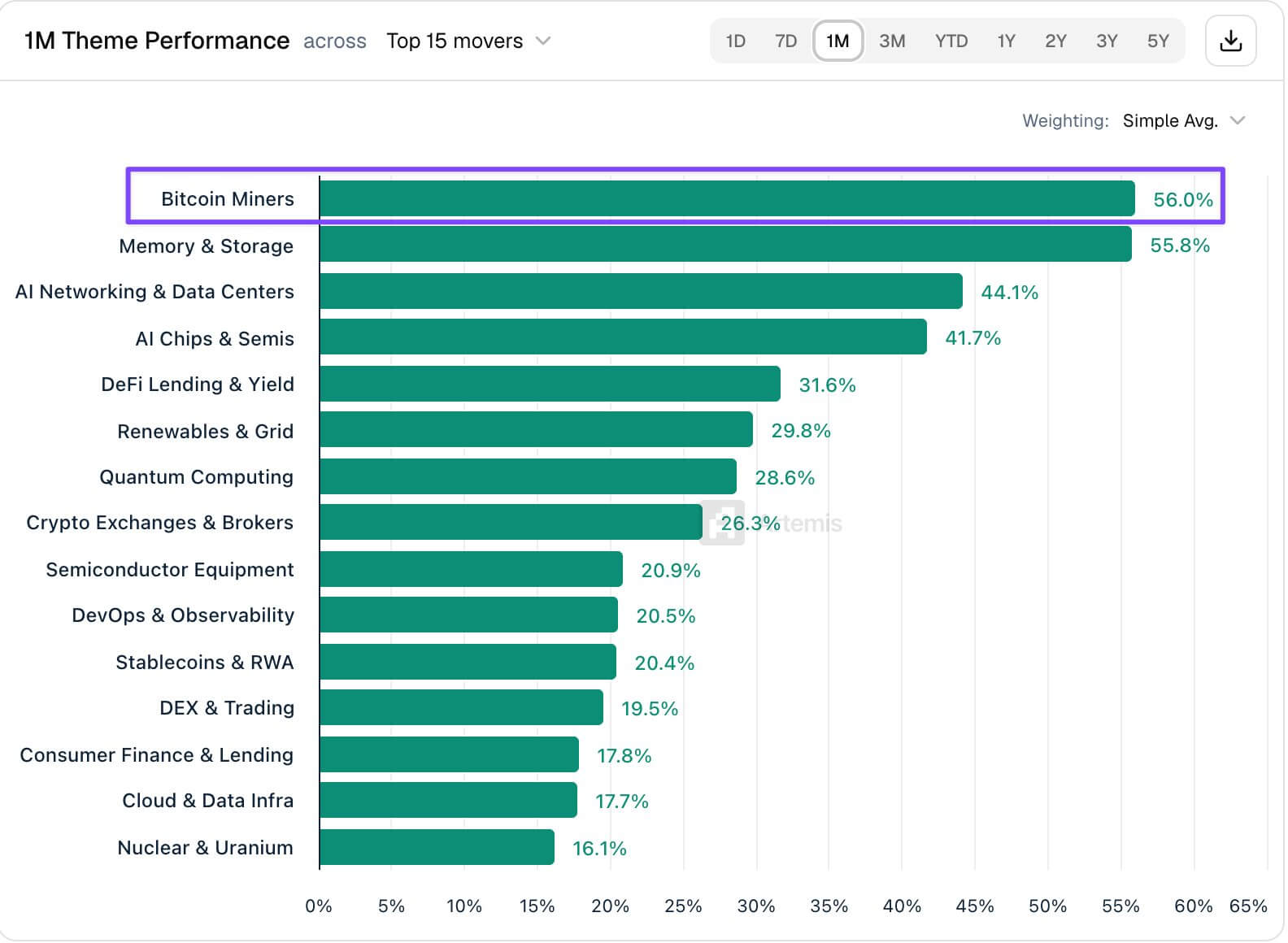
That price action reflects a market increasingly willing to value miners for their power portfolios rather than only for their Bitcoin production.
Modular Capital’s research points to the same constraint. The firm said AI workloads require sustained high-density power at a scale that the existing grid interconnection process cannot deliver quickly.
It estimated that data centers, which now account for about 3% to 4% of total US grid consumption, could reach 12% by 2028 as hyperscaler capital expenditure runs near $650 billion this year.
The grid queue makes the scarcity more acute. Modular said large-load interconnection timelines can stretch four years or more, while ERCOT, the Texas grid operator, has roughly 458 gigawatts of pending applications.
In PJM, the grid region covering Virginia, Ohio, Pennsylvania, and much of the Northeast, a new large-load interconnection is broadly stalled after available supply capacity fell 20% over four years. Large transformers can take two to three years to procure, and substations for loads above 100 megawatts can add another 18 to 24 months.
Those delays explain why BTC miners have become attractive candidates for AI infrastructure. Many of them had secured power contracts before the AI buildout intensified. Some already have land, interconnections, and operating experience with industrial-scale energy use.
However, a mining site still needs significant work before it can host advanced AI workloads, but the most valuable asset may be its place in the power queue.
Musk enters the race
SpaceX’s Colossus deal changes the competitive map because it shows that the power trade is attracting companies with deeper capital pools and broader technology platforms.
Neocloud operators buy or lease large pools of GPUs and rent computing capacity to AI developers. Bitcoin miners have been trying to move into that market by offering powered shells, colocation, and, in some cases, cloud services.
Musk’s ecosystem can approach the same market from another angle by building massive AI clusters for internal use, then leasing capacity when workloads shift elsewhere.
For context, Musk reportedly said SpaceX had moved its AI training efforts to Colossus 2 and would provide computing capacity to other AI companies making similar efforts to favor humanity.
This comment suggests Colossus 1 became available because SpaceX’s own training work had already moved to a newer site, allowing the company to monetize an existing asset without abandoning its broader AI ambitions.
That is a different kind of competition for BTC miners. A converted mining site may offer cheap power and faster time-to-market than a new data-center project. Colossus offers immediate scale, a frontier AI customer, and a platform tied to Musk’s broader ambitions in AI, space, and infrastructure.
Anthropic also said it is interested in working with SpaceX on multiple gigawatts of orbital data centers, a long-range concept that would use solar power in space and require major technical and capital commitments.
That broadens the competitive field for BTC miners as they are no longer pitching AI conversion only against other miners. They are competing with hyperscalers, neoclouds, energy developers, infrastructure funds, and technology platforms that can build or reallocate capacity at enormous scale.