



A Bitcoin miner-stress signal circulating on X has fallen into a zone analysts associate with severe miner pressure, putting a familiar cycle claim back in view: miner pain can appear near market bottoms.
The operating consequence is more immediate. If hashprice remains weak, the next test is which miners can keep machines online, avoid forced BTC sales, and wait for difficulty relief.
The latest signal came from analyst Gaah, who said the Miner Cycle Stress Composite for Bitcoin had fallen to new 2026 lows in undervalued territory. BitcoinNewsCom amplified the insight, describing it as a composite of the Puell Multiple and an inverted Miner Capitulation Index, while Wu Blockchain framed the reading as historically rare.

Treat the composite as an analyst-built stress lens. The core network variables remain hashprice, difficulty, hashrate, and miner balance sheets. That boundary prevents the signal from becoming a binary bottom call and shifts attention to the pressure that forces miners to act.
Hashprice sets the pressure
The Puell Multiple measures miner revenue relative to the value of newly issued bitcoin. Bitcoin Magazine Pro defines it as the daily dollar value of new BTC issuance, divided by the 365-day moving average of that same issuance. In plain English, it compares current miner issuance revenue with its own one-year baseline.
That lens works for miners, since they operate cash-based businesses. Power, hosting, debt service, machines, repairs, and staff all compete with block reward income. When the dollar value of rewards falls, weak operators run out of room first.
Hashprice is the cleaner way to see that pressure. Luxor’s Hashrate Index documentation defines hashprice as the expected value of one petahash per second of Bitcoin mining power per day. In dollar terms, it reflects block subsidy, transaction fees, network difficulty, and Bitcoin’s price. BTC can trade above prior lows while miners still face stress if difficulty, fees, or fleet efficiency leave each unit of hashrate earning less.
The recent backdrop is already tight. Hashrate Index’s June 1 roundup showed the USD hashprice falling 9.0% over the week to $32.56 per PH/s/day, while its forward market priced the next six months at an average of $31.71. Two weeks later, its June 15 roundup showed a rebound to $33.74, with the six-month forward average still at $32.13.
That rebound left a sharp split between strong and weak fleets. Hashrate Index estimated that sub-19 J/TH fleets earned about $81 per MWh of compute revenue, while 25-38 J/TH fleets earned roughly $43 per MWh. The same Bitcoin price can keep modern, low-cost sites operating while older or more expensive fleets move toward curtailment.
That spread is where a chart signal becomes an operating test. Miners with newer machines, cheap power, flexible curtailment agreements, or access to capital can wait for difficulty relief. Miners with older hardware, expensive hosting, or debt-heavy balance sheets have fewer ways to absorb another weak hashprice stretch.
Who gets squeezed
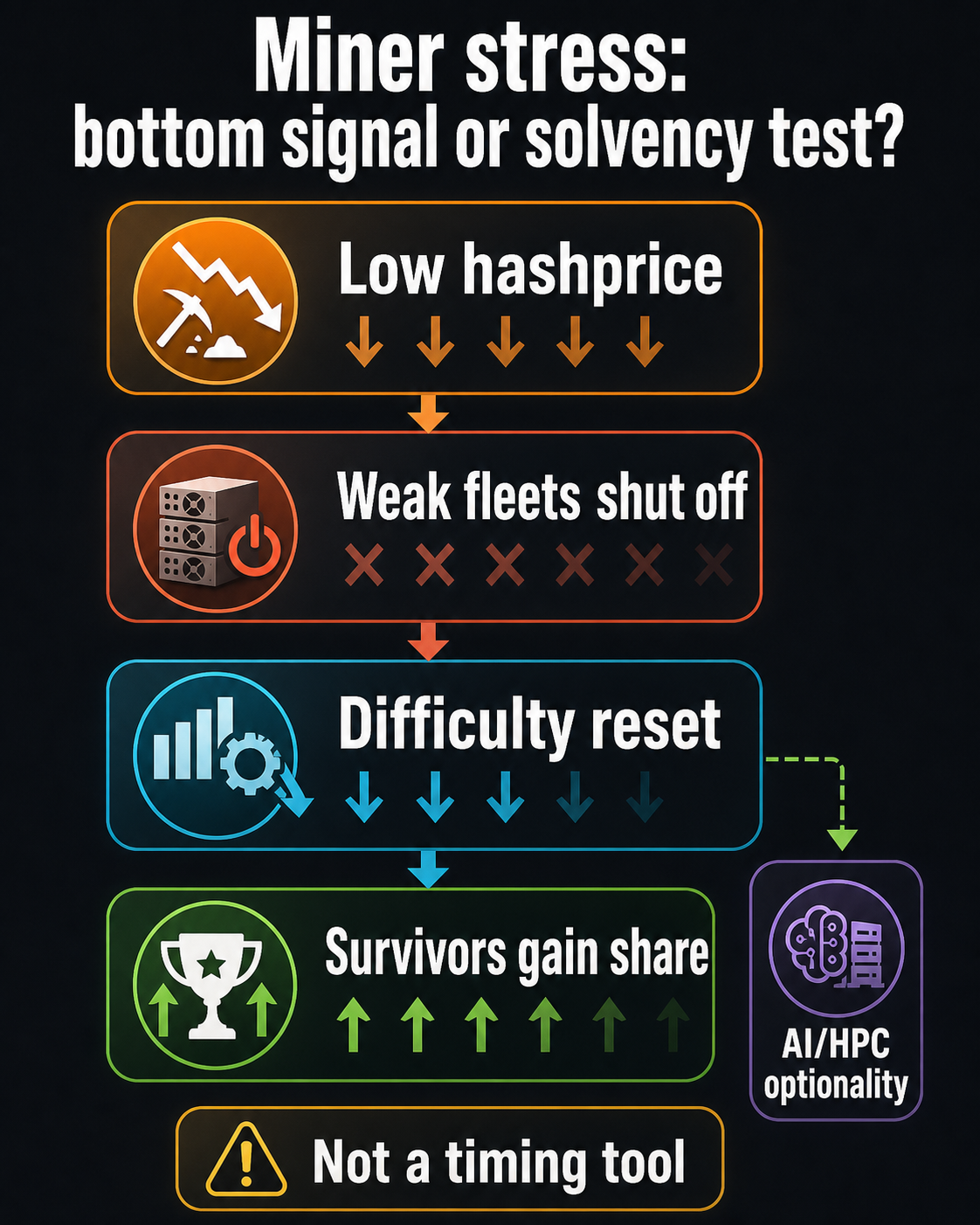
Miner stress can become self-correcting, but the adjustment hurts. When machines shut off, network hashrate can fall. If that drop persists into Bitcoin’s adjustment window, difficulty can reset to a lower level, improving revenue for the miners still online.
That is why miner capitulation can show up near cycle lows. The weakest operators leave first. The survivors get a larger share of rewards after difficulty adjusts. A lower difficulty environment can then help stabilize margins if Bitcoin’s price and transaction fees stop sliding.

The current setup already shows that mechanism. Hashrate Index’s Q2 2026 heatmap update described Bitcoin mining’s recent shift as primarily economic in nature. Its 30-day simple moving average for network hashrate fell to 1,004 EH/s in Q2 from 1,066 EH/s in Q1, a 5.8% quarterly decline. The report said older 25+ J/TH hardware was operating at negative gross margins at all-time-low hashprice levels and estimated that 252 EH/s of marginal capacity was offline.
The Bitcoin price itself remains the anchor of the economics. CryptoSlate market data showed BTC trading at $63,007 on July 6, 2026, with a $1.26 trillion market cap and 58.0% dominance. Yet miner profitability depends on a specific mix of price, fees, difficulty, power costs, and machine efficiency.
If hashprice holds in the low-$30s, the first pressure line is curtailment. Operators with high power costs or older machines can shut off during uneconomic windows, particularly if power can be resold or redirected. The second is treasury behavior. Miners that hold BTC can sell coins or borrow against assets, adding pressure during periods when liquidity is already thin.

The third is consolidation. Low-cost miners, better-capitalized public companies, and operators with newer fleets can outlast weaker rivals and potentially absorb sites, power contracts, or market share after difficulty relief improves the reward split.
The fourth is the AI-and-high-performance-computing pivot. CryptoSlate has already reported that some miners are becoming less pure Bitcoin proxies as stressed miners sell coins, stronger operators pursue AI, and public mining equities begin to trade partly on data-center execution.
Only some miners have the power, land, cooling, capital, and customers to make that pivot credible. Hashprice pressure raises the value of that option for operators that do.

Signals to watch
The miner-stress composite is most useful as an alarm, not a calendar. It says miner revenue pressure has reached a level seen in past stress regimes. It leaves open whether the market has already finished repricing that stress.
The next signals are more concrete: whether hashprice can recover above the low-$30s zone, whether difficulty continues to adjust lower, whether hashrate stabilizes, whether public miners sell more BTC, and whether AI/HPC announcements become funding necessities rather than growth stories.
If those signals improve together, miner stress could, in hindsight, look like another bottom-building phase. If they deteriorate, the same reading could mark a deeper shakeout, with inefficient fleets losing hashrate share before the network resets in favor of survivors.
That is why this bottom signal also serves as a solvency test. The chart may catch attention because it resembles past cycle lows, but hashprice will decide which miners are still around if the recovery takes longer than the signal’s supporters expect.