


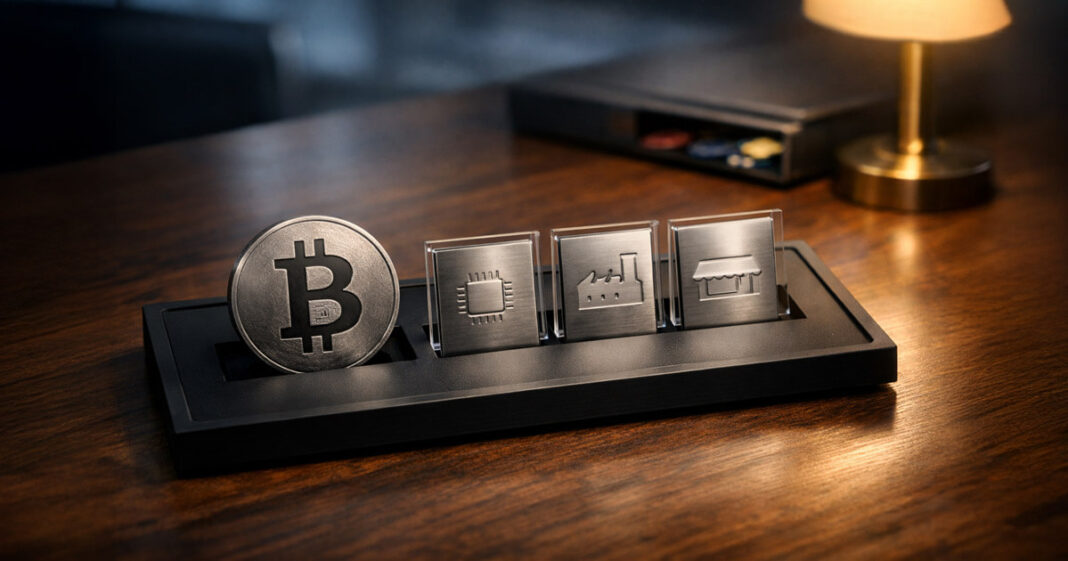

Crypto promised diversification beyond Bitcoin. For years, the pitch was simple: spread risk across blockchains, decentralized applications, and layer-1 protocols.
In practice, that diversification often collapsed when Bitcoin stumbled. Ethereum, Solana, and other major altcoins routinely fell harder than BTC during drawdowns, leaving portfolios concentrated on the same directional bet, just with different branding.
Now, the institutions that process trillions in traditional securities trades are sketching a different path. On this path, diversification comes not from more crypto tokens but from tokenized versions of the assets investors already want.
DTCC, Clearstream, and Euroclear released a joint white paper with Boston Consulting Group outlining how digital asset securities could achieve interoperability across blockchains and traditional finance rails.
The document outlines technical frameworks, custody models, and settlement protocols that enable stocks, bonds, and funds to trade and settle on distributed ledgers. The report also noted stablecoins increasingly serving as the cash component of transactions.
The market infrastructure already exists: daily repo operations exceed $300 billion, global equity markets total $126.7 trillion, and stablecoin circulation has grown past $300 billion.
What’s missing isn’t scale or capital, but the connective tissue between fragmented ledgers and the legal certainty that underpins traditional finance.
The question for anyone holding altcoins as a portfolio hedge becomes sharper: if tokenized equities and fixed income arrive on crypto rails with the same custody, settlement, and compliance infrastructure that underpins traditional markets, why would diversification require buying more blockchain protocols?
Bucket
What it represents
Size (today / cited)
Why it matters to your thesis
Global equities
Investable diversification universe
$126.7T
This is the “diversification inventory” crypto rails want to access
Repo market activity
Institutional plumbing already huge
$300B+ daily
Shows TradFi already operates at massive scale where settlement efficiency matters
Stablecoin float
“Cash leg” building block
$300B+
Settlement currency bridge for onchain DvP
Tokenized Treasuries
Early product-market fit
~$11B
The first credible non-crypto “diversifier” living onchain
Tokenized assets by 2030
Market-size range
$2T base / $4T bull (McKinsey)
Shows why rails matter even if timelines are uncertain
Tokenized funds by 2030
Subset forecast range
>$600B (BCG) / $120B (Amundi)
Highlights uncertainty + still-big lower bound
The diversification that wasn’t
Altcoin performance during risk-off periods reveals the problem.
Coin Metrics data from February 2026 shows Bitcoin’s drawdown erased nearly half of its peak value, while Ethereum and Solana fell roughly 34% and 35%, respectively. As a result, these altcoins’ prices fell back to levels seen before spot ETF approvals.
These weren’t isolated incidents. Across cycles, most altcoins have tracked Bitcoin’s direction with amplified volatility, behaving less like independent assets and more like leveraged exposure to the same underlying risk factor.
Bitcoin dominance climbed toward 64% in 2025, while the total altcoin market cap remained below prior cycle highs of around $1.1 trillion. The universe expanded, but capital concentrated.
For investors who added Ethereum or Solana, expecting portfolio stabilization during BTC corrections, the reality delivered correlation without the offsetting returns.
Meanwhile, traditional equity markets delivered.
The S&P 500 has outperformed most major altcoins over multi-year periods. From January 2024 to press time, the SPX rose nearly 45%. Meanwhile, Ethereum and Solana tanked 6% and 10%, respectively, in the same period.
S&P 500 gained 45% while Ethereum fell 6% and Solana dropped 10% between January 2024 and March 2026.
Investors seeking diversification had a straightforward alternative: hold Bitcoin for crypto exposure and allocate the rest to equities, bonds, or commodities through conventional brokerage accounts.
The friction stemmed from the separation: crypto lived in one set of accounts, traditional assets in another, with different settlement systems and custodians.
Tokenized securities as infrastructure, not speculation
The DTCC paper doesn’t promise imminent retail access to tokenized Apple shares or Treasury bonds.
Instead, it describes the architecture required for digital asset securities to scale: interoperability frameworks that enable assets to move between distributed ledgers and traditional infrastructure without disrupting ownership records, settlement finality, or legal enforceability.
The institutions involved process the overwhelming majority of global securities transactions.
Their participation signals this isn’t speculative infrastructure for decentralized finance protocols, but an established market plumbing adapting to new rails.
The core insight is that stablecoins have evolved into a functional settlement currency.
Circulation grew more than 75% year-to-date to reach $290 billion, filling what the paper calls the “cash leg” in transactions.
That creates a pathway for delivery-versus-payment settlement, where a tokenized bond or equity is recorded on a single ledger. In contrast, stablecoin payments move on another chain, or both legs settle atomically on the same chain.
The efficiency gains matter most for institutional workflows. Still, the structural shift affects retail investors too: if stocks can settle in stablecoins on blockchain rails, the boundary between crypto portfolios and traditional portfolios starts to dissolve.
Tokenized Treasury funds already demonstrate product-market fit. RWA.xyz data shows tokenized Treasuries nearly touching $11 billion. These are yield instruments that settle faster and operate around the clock, appealing to institutions managing cash and collateral.
Tokenized money market funds, corporate bonds, and, eventually, equities follow similar logic: the same legal rights, the same economic exposure, and lower settlement friction.
The catch is fragmentation. Digital asset securities currently exist across dozens of public layer-1 and layer-2 blockchains, as well as permissioned enterprise-ledgers.
Each network uses different smart contract languages, consensus mechanisms, and token standards.
The paper argues that the end state isn’t a single dominant blockchain but a “network-of-networks” in which standards, gateways, and regulated intermediaries connect distributed ledgers to traditional financial infrastructure.
That architecture requires harmonization across data formats, custody rules, message protocols, and legal enforceability.
What tokenized markets mean for altcoin diversification
If interoperability standards mature and tokenized securities become portable across venues, the diversification trade shifts.
An investor holding Bitcoin who wants non-correlated exposure to economic growth, dividend income, or interest rate movements no longer needs to buy Ethereum or Solana to access different risk factors.
They can hold tokenized equity index funds, sector ETFs, or fixed-income instruments within the same wallet infrastructure, settled in stablecoins, with custody models that mirror traditional brokerage segregation.
Related Reading
How XRP quietly became the blueprint for the next wave of crypto ETFs
The winners won’t be the loudest tokens, they’ll be the ones that can build regulated rails and clear the new timeline.
Mar 4, 2026
·
Gino Matos
This doesn’t eliminate all use cases for altcoins. Tokens with clear cash flows, such as transaction fees, staking yields, and protocol revenue sharing, remain investment candidates on their own merits.
Assets that function as collateral in decentralized finance or as settlement primitives in on-chain markets have structural demand beyond price appreciation.
Projects building interoperability infrastructure, custody solutions, or identity and compliance tooling benefit if tokenized securities adoption accelerates.
However, none of those cases depend on altcoins serving as portfolio diversifiers. They’re venture-style bets on specific protocols or business models, not hedges against Bitcoin volatility.
The empirical case for holding altcoins as diversification has already weakened.
The forward case depends on whether investors believe another blockchain’s success will diverge meaningfully from Bitcoin’s.
Recent cycles suggest skepticism. The alternative is straightforward: own Bitcoin for crypto exposure, own tokenized equities and fixed income for diversification, and treat any altcoin positions as concentrated bets rather than as part of portfolio construction.
Related Reading
Altcoins outside the top 10 won’t recover when Bitcoin finally rebounds, and here’s why
Coin Metrics data shows the top 10 alts now hold about 82% of the market cap excluding Bitcoin. That leaves the long tail fighting for scraps even in “recoveries.”
Jan 30, 2026
·
Gino Matos
The timeline and the friction
Tokenized securities won’t replace conventional markets quickly. The DTCC paper identifies multiple obstacles: consensus and finality rules vary across chains, creating settlement risk when transactions span networks.
Legal enforceability of tokenized transfers remains inconsistent across jurisdictions.
Custody models need standardization so omnibus accounts, segregated wallets, and multi-tier chains can interoperate without breaking client asset protection. Data privacy requirements conflict with transparency norms on public blockchains.
Market forecasts reflect this uncertainty.
McKinsey projects $2 trillion in tokenized financial assets by 2030 in a base case, with a bull scenario reaching $4 trillion. BCG estimates tokenized funds alone could exceed $600 billion by 2030. A more conservative view from Amundi suggests $120 billion for tokenized funds in the same timeframe.
The range is wide, but even the lower bound represents a significant scale, and none of these forecasts include cryptocurrencies or stablecoins, which already circulate at over $300 billion.
For near-term adoption, tokenized funds and Treasuries are more plausible than individual equities.
Funds offer regulatory simplicity, familiarity among existing investors, and operational advantages in settlement and liquidity management.
The path of least resistance runs through institutional adoption of tokenized money market funds and Treasury products, and eventually fixed-income and equity funds, with retail access mediated through regulated platforms.
Several indicators will clarify whether tokenized securities become a mainstream diversification option: stablecoin supply growth and regulatory treatment, adoption of interoperability standards, production deployments beyond pilots, clarity on investor protection, and distribution breadth.
None of these developments invalidates Bitcoin or eliminates speculative interest in altcoins. However, they do challenge the premise that crypto portfolios need altcoins for diversification.
Related Reading
A $1.2T shift toward Bitcoin may be starting — and one grim index says altcoins may never rally
Historical patterns suggest a potential $1.2 trillion shift from altcoins to Bitcoin in this current bear market situation.
Feb 19, 2026
·
Oluwapelumi Adejumo
The institutions building these rails control the infrastructure that processes the vast majority of global securities transactions. Their entry doesn’t guarantee rapid adoption, but it establishes credible pathways for tokenized markets to scale without relying on crypto-native speculation.
For investors evaluating altcoins today, the relevant question isn’t whether blockchain technology has value, but whether diversification requires exposure to blockchain protocols, or just to diversified assets that happen to settle on blockchain rails. The answer increasingly points toward the latter.
The post Bitcoin investors may not need altcoins to diversify if tokenized stocks move on-chain appeared first on CryptoCho